
Genie 4 enters research preview with live scene editing and native audio
Google DeepMind is testing interactive world simulation with a small trusted group, combining native audio with Gemini guidance. Broader access is still pending; long-term consistency and physical accuracy remain limitations.
On October 27, Google DeepMind announced Genie 4 and began a research preview with a small group of trusted testers. Rather than delivering a fixed clip, the model continues a scene as a user moves or changes the request. Native sound and an ongoing Gemini guidance loop are central additions.
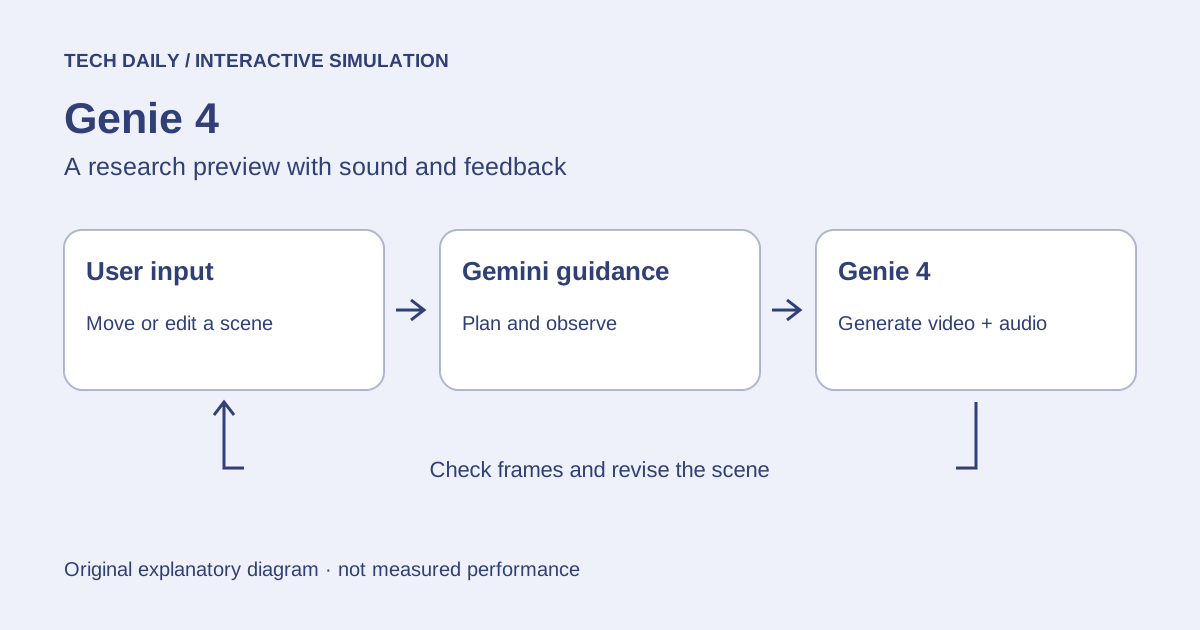
- A user supplies a goal or action
- Gemini plans and observes frames
- Genie 4 generates subsequent video and audio
- Observe and revise; drift can still accumulate
A scene that responds to actions
A video generator usually produces a clip; an interactive world model must carry the preceding state forward after a new action. Genie 4 supports keyboard navigation, camera control and text edits during a simulation, including changing weather or introducing a character. Ambient sound, music and dialogue are generated with the world rather than simply added afterwards.
DeepMind describes Gemini Omni as a foundation for appearance and behaviour, while Gemini 3.8 Flash acts as a guide: breaking a goal into steps, observing frames and checking progress. We interpret this as a feedback-driven generation process. That explains the intended role of continuous guidance, but does not establish that every correction succeeds.
What the robot demonstration establishes
A separate research experiment pairs Gemini 4 Argon with Genie 4 around a simulated Apptronik Apollo robot playing checkers. Planning and scene generation illustrate a possible connection between reasoning and visual simulation. The demonstration takes place inside a generated environment; it is not evidence that a physical robot completed the same task.
Creative prototyping could tolerate some visual errors while a robot-training environment needs stable relationships with real physics. In our reading, these are different validation burdens. Faster experimentation with scenes is a plausible use, but improved real-world robot training has not been established by this announcement.
Preview access and unresolved limits
The available release is the trusted-tester research preview. Project Genie for Google AI Ultra subscribers, and access for early Gemini API and AI Studio partners, remain forthcoming. Google’s short announcement and independent coverage distinguish these stages. This is neither general availability nor an open-weights release.
DeepMind acknowledges that objects and details can drift during longer sessions, complex edits and navigation. Physical interaction, audio accuracy, readable text and spatial consistency remain research problems. Official recordings are demonstrations, not our independent tests. SynthID marking is planned for generated video and audio; a watermark is not a guarantee of truth or simulation accuracy.




Comments
Join the conversation with your GitHub account. All language editions share this discussion.
View discussion on GitHubPrevious comments (Disqus)